What Is the 3-3-3 Journaling Method?
What is the 3-3-3 journaling method, in one paragraph?
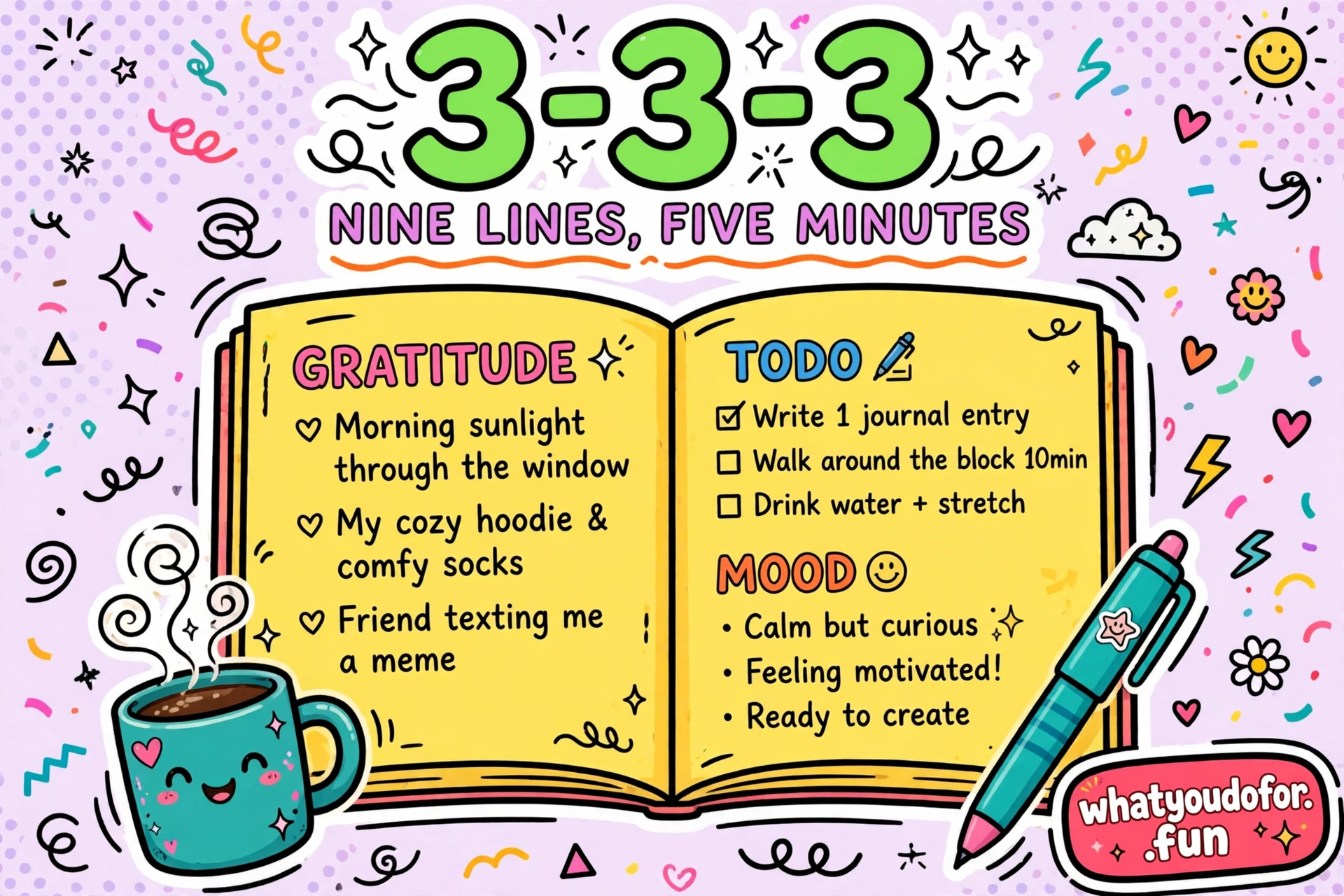
What is the 3-3-3 journaling method? In its most widely shared beginner form, it is a nine line journal entry made of three short lists: three things you are grateful for, three things you want to focus on today, and three positive affirmations about yourself. You write nine short lines, usually in about five minutes, and you are done. There is no essay to finish, no blank page to stare at, and no rule that says your lines have to sound profound. Coffee counts as gratitude. Drinking a glass of water counts as a focus for the day. That smallness is the whole point.
Here is the honest catch, and it matters: there is no single official 3-3-3 journaling method. The name is used for several different routines, and different guides mean different things by it. This article explains the classic version first, because it is the one most beginner guides describe, then shows you the other common versions, so you can pick the one that actually fits your day instead of following a version you did not sign up for.
Why does the name mean different things in different places?
Journaling methods spread the way recipes do: someone shares a neat format, other people adapt it, and the name travels faster than the original instructions. The number three is doing most of the work in all of them. Three is small enough to finish on a busy morning and large enough to make you stop and think. So different writers have filled the three slots with different prompts, and all of them now circulate under the same name.
The four versions you will meet most often are these. First, the classic beginner version: three things you are grateful for, three things to focus on, and three affirmations. Second, the sensory grounding version: three things you can see, three things you can hear, and three things you can feel, written in the present tense. Third, the evening review version: three bad things that happened, three good things that happened, and three things to look forward to. Fourth, the daily record version: three things that happened today, three thoughts or feelings, and three things you are grateful for. They share a shape, nine short lines, but they do quite different jobs, and the rest of this article keeps them separate so you can choose deliberately.
How do you do the classic 3-3-3 method, step by step?
Start with a notebook or a notes app you already use. Do not buy special supplies first. The method works because it is short, and a shopping trip before your first entry is exactly the kind of delay that kills a new habit. Pick a time you can repeat, first thing in the morning if your three focus lines are for the day ahead, or last thing at night if you prefer to review the day behind you. Morning suits the classic version best, because the middle list is a plan, not a review.
Step one is gratitude: write three things you are grateful for, and be specific. “My health” is true but vague, and vague lines are hard to feel anything about. “The hot shower after a cold walk” is specific, and your brain can picture it. Small things count, and on hard days they count double, because they prove that something in the day was still good. Try to add a short reason where you can, even just a few words: “my sister called, because I needed a laugh.”
Step two is focus: write three things you want to accomplish or focus on today. These are not a full to do list. Pick three, and make them small enough to actually finish. “Finish the report” is a project. “Write the first paragraph of the report” is a step you can do before lunch. If one of your three is a kindness, a rest, or a boundary, that still counts. A day with three finished small things feels better than a day with twenty unfinished big ones.
Step three is affirmations: write three positive statements about yourself, in the present tense, as if they are already true. For example: “I am someone who keeps small promises to myself.” “I am learning to rest without guilt.” “I am good company for myself on a quiet evening.” If an affirmation feels like a lie, soften it until it feels believable. “I am calm” on a frantic morning may ring false, while “I am learning to pause before I reply” is something you can actually practise. Believable beats grand every time.
That is the whole entry: nine lines. Most people finish in three to five minutes. Read it back once, close the notebook, and get on with your day. The method is not a test, and nobody is marking your handwriting, your spelling, or your depth.
What does a finished entry actually look like?
Here is a made up example for an ordinary Tuesday, written in the morning. It is invented to show the format, not a real diary entry, and its ordinariness is deliberate. Your entries will look like this more often than they look like poetry, and that is fine.
Grateful for: the sunlight on the kitchen table at breakfast; my neighbour lending me a charger; the last episode of a show I love waiting for tonight. Focus for today: reply to two emails I have been avoiding; walk around the block at lunch; put my phone on charge before bed instead of in the morning. Affirmations: I am someone who starts small and finishes. I am allowed to rest before I am exhausted. I am becoming braver about asking for help.
Notice what is missing: there is no life story, no analysis, and no attempt to sound wise. The entry works because each line points at something concrete. If you ever read back an entry and cannot remember what you meant, that is your cue to be more specific next time, not to write more.
What does the research actually say?
Here the article has to be careful, because the 3-3-3 method itself has not been tested as a single named intervention in a published trial. What has been tested is its close cousin, the “three good things” exercise, and that is where the honest evidence lives. In that exercise, people wrote down three things that went well each day and a short explanation of why each one happened, every evening for one week.
The best known study is by Seligman, Steen, Park and Peterson, published in 2005. Participants recruited through a website tried one of five happiness exercises, including three good things, and were followed up over six months. The three good things group reported being about 2 percent happier after one week, 5 percent happier after one month, and 9 percent happier after six months, while depressive symptoms fell by an average of 28 percent within the first week. A later replication by Mongrain and Anselmo-Matthews found a similar happiness boost, which strengthens the finding, although that replication did not find the same difference between groups for depressive symptoms. Those are modest, real effects, not miracles, and they came from a self selected online sample, which is a limit worth knowing.
None of this proves that the full 3-3-3 format, with its affirmations and focus lines, will do the same thing. Gratitude writing has the strongest evidence of the three parts, goal setting is well supported as a general habit, and affirmations are the shakiest leg of the trio, which is why the believability advice above matters. Treat the method as a pleasant, low cost daily habit with some encouraging evidence behind its gratitude core, not as a treatment. If journaling regularly makes you feel worse, or if you are struggling with low mood or anxiety, the journal is not the place to work that out alone. Talk to a clinician or a trusted support service instead. A notebook is a tool, not a therapist.
Which version should you pick?
Pick by the problem you actually have at the time you sit down. If your problem is a blank page and a busy morning, use the classic version: gratitude, focus, affirmations. It gives you a plan for the day and a kinder way to talk to yourself, in five minutes. If your problem is a racing mind and you cannot settle, try the sensory version instead: three things you see, three you hear, three you feel, all in the present tense. It pulls your attention back to the room you are in, which is the point of a grounding exercise, and it takes about two minutes.
If your problem is an evening review, when the day is already over and you want to make sense of it, use the evening version: three bad things, three good things, three things to look forward to. Including the bad things on purpose stops the entry turning into forced cheerfulness, and ending on something to look forward to gives the day a gentler close. If your problem is simply remembering your days, use the daily record version: three things that happened, three thoughts or feelings, three things you are grateful for. It is the closest to a traditional diary, but it still fits on half a page.
You can also mix versions across the week. Many people use the classic version on weekday mornings and the evening review on Sundays. What matters is that you know which version you are doing on a given day. If you drift between versions without noticing, the habit feels muddled and you will blame the method instead of the mix-up.
How do you keep it going for seven days?
Start with a seven day trial, not a lifetime promise. Seven days is long enough to learn whether the format suits you and short enough that a missed day does not feel like failure. Put the notebook where the habit already lives: next to your phone charger, beside the kettle, or on your pillow. Attach it to something you already do every day, like making your first hot drink. The pairing does the remembering for you.
Here is a simple seven day starter plan. Day one, do the classic version in the morning and keep every line under ten words. Day two, do the same, but make one gratitude line more specific than yesterday. Day three, try the sensory version at a moment when your mind feels busy. Day four, return to the classic version and notice which of the three lists feels easiest. Day five, try the evening review version before bed. Day six, use whichever version you liked best so far. Day seven, read all seven entries back and circle anything that surprises you. That review is where the habit starts to feel like yours rather than a template you borrowed.
Missed a day is not a failed habit. It is a normal week. If you miss two days, restart the next morning without a catch up session. Catch up sessions turn a five minute habit into a chore, and chores are the first thing a busy life drops. If you miss a whole week, start a fresh seven days. The notebook does not keep score, and neither should you.
What are the common mistakes?
The first mistake is writing generic gratitude on repeat. “Family, friends, health” for thirty days teaches you nothing and bores you out of the habit. Specific beats grand: a text from a friend, a warm coat, a song on the radio. The second mistake is affirmations you do not believe. A line that makes you roll your eyes does not rewire anything; it just trains you to ignore your own journal. Soften the claim until it is true, then let it grow.
The third mistake is turning nine lines into nine paragraphs. Long entries have their place, but they are a different habit. If your 3-3-3 entry keeps sprawling, set a timer for five minutes and stop when it rings. The fourth mistake is only journaling on good days. Good days are easy to write about. The habit earns its keep on ordinary and difficult days, when three small good things are harder to find and therefore more useful to notice. The fifth mistake is using the journal to ruminate, writing the same worry over and over until it feels bigger. If you notice that pattern, switch to the sensory version for a few days, which describes the room rather than the worry, or put the notebook down and talk to someone you trust.
Is 3-3-3 better than other quick journaling methods?
There is no honest overall winner, because the methods do different jobs. A one line a day journal is better if you want a memory record with almost no effort. A timed five minute routine suits people who like a fixed start and finish. The 3-3-3 method is better if you want a balance of looking back with gratitude, looking forward with focus, and speaking kindly to yourself, all in one short entry. Its strength is that balance, and its weakness is that three lists can feel like homework on a tired day.
One close cousin deserves a mention so you are not confused when you meet it: the 3-2-1 method, which uses three observations, two feelings and one question in some versions, and different numbers in others. Like 3-3-3, the name covers more than one routine, so check which version a guide means before you follow it. The two methods are not rivals. They are both short templates for people who do not want a blank page, and the best one is the one you will still be using next month.
Frequently asked questions
What is the 3-3-3 journaling method? In its most common beginner form, it is a nine line entry: three things you are grateful for, three things to focus on, and three affirmations. Other versions use the same three by three shape with different prompts, so always check which version a guide means.
How long does the 3-3-3 journaling method take? Most entries take three to five minutes. The sensory grounding version takes about two minutes, because it only asks you to name what you see, hear and feel right now.
Is there one official 3-3-3 journaling method? No. The name is used for several routines, including a gratitude and focus version, a sensory version, and an evening review version. This article leads with the gratitude, focus and affirmations version because it is the one most beginner guides describe.
Should I do the 3-3-3 method in the morning or at night? Morning suits the classic version, because the middle list plans the day ahead. Evening suits the review version, which looks back at the day and forward to something good. Pick the timing that matches the version you chose.
What if I cannot think of three things? Lower the bar, not the habit. A hot drink, a comfortable chair and a song you like are three genuine gratitudes. A finished entry with small lines beats a perfect entry you never write.
Does journaling replace therapy? No. Journaling is a pleasant daily habit with some encouraging evidence behind its gratitude core, but it is not a treatment for depression, anxiety or any other condition. If you are struggling, speak to a clinician or a support service.
Sources
The 3-3-3 name covers several routines: a nature journaling guide notes that you should check which version a source means, and describes the sensory version of three things you see, hear and feel. A beginner guide to the classic rule describes it as three things you are grateful for, three things you want to accomplish, and three positive affirmations. A college journaling piece describes the evening version as three bad things, three good things, and three things to look forward to. A beginner anxiety journaling guide describes the sensory grounding version in present tense detail. The three good things evidence comes from Seligman and colleagues in 2005, summarised in a breakdown of the paper and in a counselling guide, with a replication by Mongrain and Anselmo-Matthews noted in the same guide.
Journaling in Nature: A Beginner’s Guide (Cozy Journal)
The Journal Prompt That Changed My Life (Her Campus)
How to Start Journaling for Anxiety: A Beginner’s Guide (Planneher)
Three Good Things Journaling Method (Apartment Therapy)
Three Good Things Exercise (Counselling Directory)
Positive Psychology Progress: A Breakdown of the 2005 Paper (Happier Human)
Related reading
Fun Winter Projects for Adults to Try at Home
How to Make a Home More Cosy in Winter
The Top 10 Hobbies for Couples to Try Together

Related Posts
Why Do My Weekends Feel So Short?
What Is the 2-2-2 Rule for Couples?