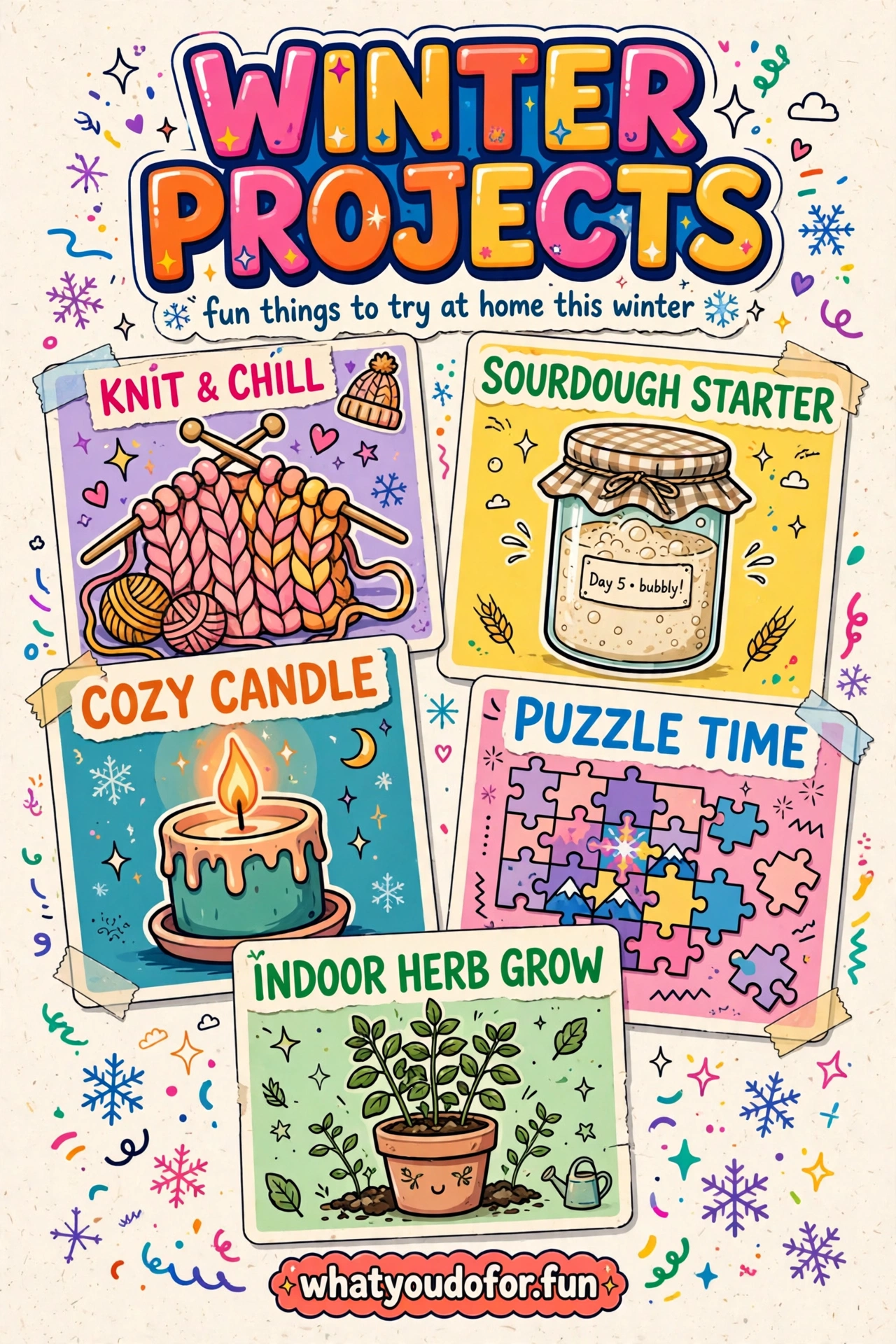
Fun Winter Projects for Adults to Try at Home
What are some fun winter projects for adults?
The best fun winter projects for adults are ones you can start at home, finish in stages, and actually enjoy doing: knitting a chunky scarf, starting a sourdough starter, making candles, building a jigsaw habit, growing herbs indoors, making marmalade, starting a scrapbook, learning a new instrument, setting up a board game night, and creating a cosy reading corner. Pick one project, not ten, and give it a proper first evening. Winter is long, and a project that fits your evenings will beat a project that only looks good on a list.
Winter projects work best when they match the kind of evening you actually have. If you are tired, choose something gentle with your hands, like knitting or a puzzle. If you are restless, choose something with a result you can taste, like sourdough or marmalade. If you want company, choose something you can do with another person, like a board game night. The project below are all made for adults at home, with no special skills needed at the start, and each one can be paused and picked up again without losing the thread.
How to pick your winter project
Ask yourself three quick questions before you buy anything. First, do you want something to wear, eat, display, or play with? Second, do you want ten minutes a day, or a big weekend session? Third, do you want to do it alone, or with someone else? A knitted scarf suits ten quiet minutes a day. Sourdough suits someone who likes a small daily ritual. A board game night suits someone who wants people round the table. There is no best project in general, only a best project for your winter.
Set a simple rule for the first week: work on it three times, even if only for twenty minutes. That is enough to learn whether you enjoy the rhythm of it. If you do not enjoy it after three tries, swap to another project on this list without guilt. Winter is not a test of willpower. It is a season to find something that makes dark evenings feel like a treat instead of a wait for spring.
1. Knit a chunky scarf
Chunky yarn is the friendliest place to start knitting, because the stitches are big, the rows grow fast, and a mistake is easy to spot and fix. Choose a soft chunky yarn in a colour you will actually wear, a pair of thick needles to match the yarn label, and a simple pattern: cast on, knit every row, and keep going until the scarf is as long as you like. That stitch is called garter stitch, and it makes a squishy, even fabric that looks good even when it is your very first piece.
Keep your first scarf short and useful rather than perfect. A scarf that wraps once round your neck is a finished project. A scarf planned to wrap three times can turn into a chore. Knit while you watch something you have seen before, so your eyes can wander without losing your place, and count your stitches every few rows. When you finish, you will have something warm that you made, and a skill you can use for hats, blankets, and gifts next winter.
2. Start a sourdough starter
A sourdough starter is a jar of flour and water that you feed, watch bubble, and eventually bake with. It is a perfect winter project because it asks for very little, rewards patience, and turns a kitchen counter into a small science experiment. The BBC Good Food starter method starts simply: mix 50 grams of flour with 50 grams of tepid water, leave it semi-uncovered at room temperature for 24 hours, then repeat the same feed each day. After five days of feeding, the mixture should be active, bubbly, and ready to use for a loaf, and it should smell like yoghurt.
Once your starter is going, you do not need to feed it every day. The same BBC Good Food guide says you can keep it in the fridge, feeding it 100 grams of flour and 100 grams of water every week, and it can last for years with that care. Name it if you like, write the feeding day on the jar, and bake your first loaf on a weekend when you are home to enjoy the smell. If it goes quiet, feed it again for a few days before giving up. Starters are tougher than they look, and a slow starter is usually just a cold or hungry one.
3. Make your own candles
Candle making turns a plain evening into a small workshop, and the result is something you can light, gift, or use to make a room feel finished. Start with a simple kit, which usually includes wax, wicks, a container, and a thermometer, then add a scent you love, such as cinnamon, pine, or vanilla. Melt the wax gently, fix the wick in the centre of the container, pour carefully, and let the candle set fully before trimming the wick and lighting it.
Keep candle safety at the front of the project. Never leave a lit candle unattended, keep it away from curtains and anything that can catch, and set it on a stable, heatproof surface. That rule applies to candles you buy as well as candles you make. Make a small batch first, test one candle yourself, and only then make a set as gifts. A candle that burns evenly, smells gentle rather than strong, and sits in a jar you like is a better gift than a fancy candle that tunnels down the middle.
4. Start a jigsaw puzzle habit
A jigsaw puzzle is the rare winter project that is both social and solitary. Leave a puzzle out on a table, and people will drift over, find a piece, and stay for a chat. Work on it alone, and it becomes a calm way to switch off a busy mind without a screen. Choose a puzzle with a picture you genuinely like, not just a hard one, and start with 500 pieces if you are new to puzzles, or 1,000 pieces if you want a project that lasts a week or two.
Sort the edge pieces first, then sort by colour or pattern, and work in small sections rather than staring at the whole picture. Keep the puzzle board clear, store loose pieces in a tray or a zip bag, and take a photo when you finish. Framing a finished puzzle is a lovely option, but so is taking it apart and passing it on. The fun is in the finding, not in keeping every puzzle forever.
5. Grow herbs on a windowsill
An indoor herb garden is a winter project that pays you back in cooking. Basil, parsley, chives, and mint all grow well in pots on a bright windowsill, and snipping fresh herbs into a meal feels like a small luxury in January. Use pots with drainage holes, ordinary multi-purpose compost, and a sunny spot, and water only when the top of the compost feels dry. Too much water kills more herbs than too little, so let the pots dry out a little between waterings.
Winter is also a good time to plan ahead for spring. The Royal Horticultural Society notes that sowing seeds indoors is a way to get plants off to an early start and protect them from cold weather, and that sowing times vary by plant, so you should check the seed packet for guidance. As a general guide, the RHS says most tender and half-hardy flowers and vegetables are sown in spring, flowers such as foxgloves and fast-growing vegetables such as salads are sown in summer, and tender crops that need a long season, such as chillies, are sown in late winter. Order your spring seeds in winter, label every pot, and start the slow growers first.
6. Make a batch of marmalade
Winter citrus season makes marmalade a perfect cold-weather kitchen project. Seville oranges, the traditional marmalade orange, are sharp, fragrant, and only around for a short season, which is exactly what makes the project feel special. Wash and halve the oranges, simmer the peel until soft, add sugar, and boil until the marmalade sets. A cold plate test, where a spoonful wrinkles when pushed after a minute in the fridge, tells you the set is ready.
Make a small batch first, in a large pan with plenty of room for bubbling, and sterilise your jars in a hot oven before filling them. Label each jar with the date and the orange type, and keep one jar for yourself before giving the rest away. Homemade marmalade on hot toast, in a cake, or stirred into a glaze for roast vegetables is a reminder that winter cooking can be bright, not just heavy.
7. Start a scrapbook of the year
A scrapbook is a winter project with a built-in reward: you get to look back at the year while you make something from it. Gather photos, ticket stubs, postcards, menus, and notes from the past twelve months, and sort them into a loose order before you glue anything down. A simple approach works best: one page per month, one photo per page to start, and a short caption in your own words about what you remember.
Do not aim for a perfect album. A scrapbook that is finished and a little messy beats a scrapbook that stays in a box because every page had to be flawless. Use acid-free paper if you can, keep fragile items in pockets rather than gluing them, and leave blank pages at the back for the rest of winter. When you look back at it next year, the captions will matter more than the decorations.
8. Learn a simple instrument
Winter evenings are made for learning an instrument, and the ukulele is one of the easiest places to start. It has four strings, a small body, and a set of beginner chords that let you play a recognisable song within a few practice sessions. Choose a soprano or concert ukulele that feels comfortable to hold, learn three chords first, and practise for ten to fifteen minutes a day rather than in one long weekend burst.
Pick songs you already know and like, because you will hear when you get them right. Strum gently, keep your nails short on your fretting hand, and tune the instrument before each session, since a badly tuned instrument makes even good playing sound wrong. If the ukulele is not for you, the same rule applies to a keyboard, a harmonica, or a guitar: start small, practise little and often, and let the first song be a simple one you enjoy.
9. Set up a regular board game night
A board game night is a winter project that builds a habit, not just a collection. Pick one evening a week, invite the same small group, and start with games that take under an hour and are easy to explain. Cooperative games, where everyone wins or loses together, are a kind choice for a mixed group, while short strategy games suit players who like a little competition. Keep snacks simple, phones in another room, and the first game short, so nobody feels trapped at the table.
Rotate who chooses the game each week, and keep a simple score sheet or a list of games you have tried, so you can remember what worked. If you want more ideas for evenings in with another person, our guide to what couples can do for fun indoors has 25 ideas, from indoor picnics to pillow fort sleepovers. A game night that happens every week, even with just two or three people, will do more for your winter than a shelf full of games nobody opens.
10. Create a cosy reading corner
A reading corner is a project you can finish in a weekend, and it changes how winter evenings feel. Choose a chair you can sit in for an hour without fidgeting, add a lamp that lights the page without glaring, and put a small table or basket beside it for books, tea, and a blanket. Move the chair near a window if you can, so daylight does the work during the day, and add a warm throw and a cushion in a colour that makes you smile.
Stock the corner with books you actually want to read, not books you think you should read. A mix works well: one novel, one book of short stories or essays, and one fun book you can dip into for ten minutes. Set a simple habit, such as twenty minutes before bed, or a chapter with your morning tea, and keep the corner tidy. A space that is ready to use will get used, while a space that needs clearing first will not.
How to keep a winter project going
The hardest part of any winter project is the middle, when the novelty fades and the finish still feels far away. Keep the project visible, not packed away in a cupboard, and work on it at the same time each day if you can. A basket by the sofa for knitting, a puzzle on the table, or a starter jar on the counter all act as gentle reminders. Track small wins, such as rows knitted, pages read, or loaves baked, and celebrate the first finished piece, however small it is.
If you stall, change the scale, not the project. Knit a hat instead of a blanket, bake one loaf instead of four, or play one short game instead of a long one. Winter projects are meant to make the season kinder, and a smaller finished project is a better winter story than a grand unfinished one. When spring arrives, you will have a scarf, a starter, a scrapbook, or a habit to show for the dark months, and that is a good trade.
Fun winter projects FAQs
What are some fun winter projects for adults at home?
Knitting, sourdough, candle making, jigsaws, indoor herbs, marmalade, scrapbooking, learning an instrument, board game nights, and a reading corner are all fun winter projects for adults at home. Pick the one that fits your evenings, your budget, and whether you want company or quiet time.
What is the easiest winter project for a beginner?
A chunky knitted scarf or a jigsaw puzzle is usually the easiest start, because both need little equipment, show progress quickly, and can be paused at any point. A sourdough starter is also beginner friendly, but it needs a few days of feeding before it is ready to bake with.
How much do winter projects cost to start?
Most projects on this list can start with a small kit or a few basic supplies, such as yarn and needles, a jar and flour, or a puzzle. Start with one project and a basic kit, and only buy extra tools once you know you enjoy the activity.
What winter project is best for couples?
A board game night, a puzzle, or cooking a batch of marmalade together all work well for couples, because they give you something to do side by side without needing the same skill level. Our guide to the top 10 hobbies for couples has more ideas to try together.
Can I do a winter project with no experience?
Yes. Every project on this list can be started by a beginner, as long as you choose a simple version first, follow a trusted guide for the technical steps, and accept that the first attempt will not be perfect. The second attempt is usually much better, and that is part of the fun.
Sources
- BBC Good Food, Sourdough starter: mix 50 grams of flour with 50 grams of tepid water, feed daily, ready after five days, and keep in the fridge with a weekly feed of 100 grams of flour and 100 grams of water. https://www.bbcgoodfoodme.com/recipes/sourdough-starter/
- Royal Horticultural Society, How to Sow Seeds Indoors: sowing indoors gives plants an early start and protection from cold weather, sowing times vary by plant and the seed packet should be checked, with tender and half-hardy types generally sown in spring and long-season tender crops such as chillies sown in late winter. https://www.rhs.org.uk/propagation/how-to-sow-seeds-indoors
Related reading

Related Posts
What Is the 2-2-2 Rule for Couples?

What Is the 7 7 7 Rule for Couples?