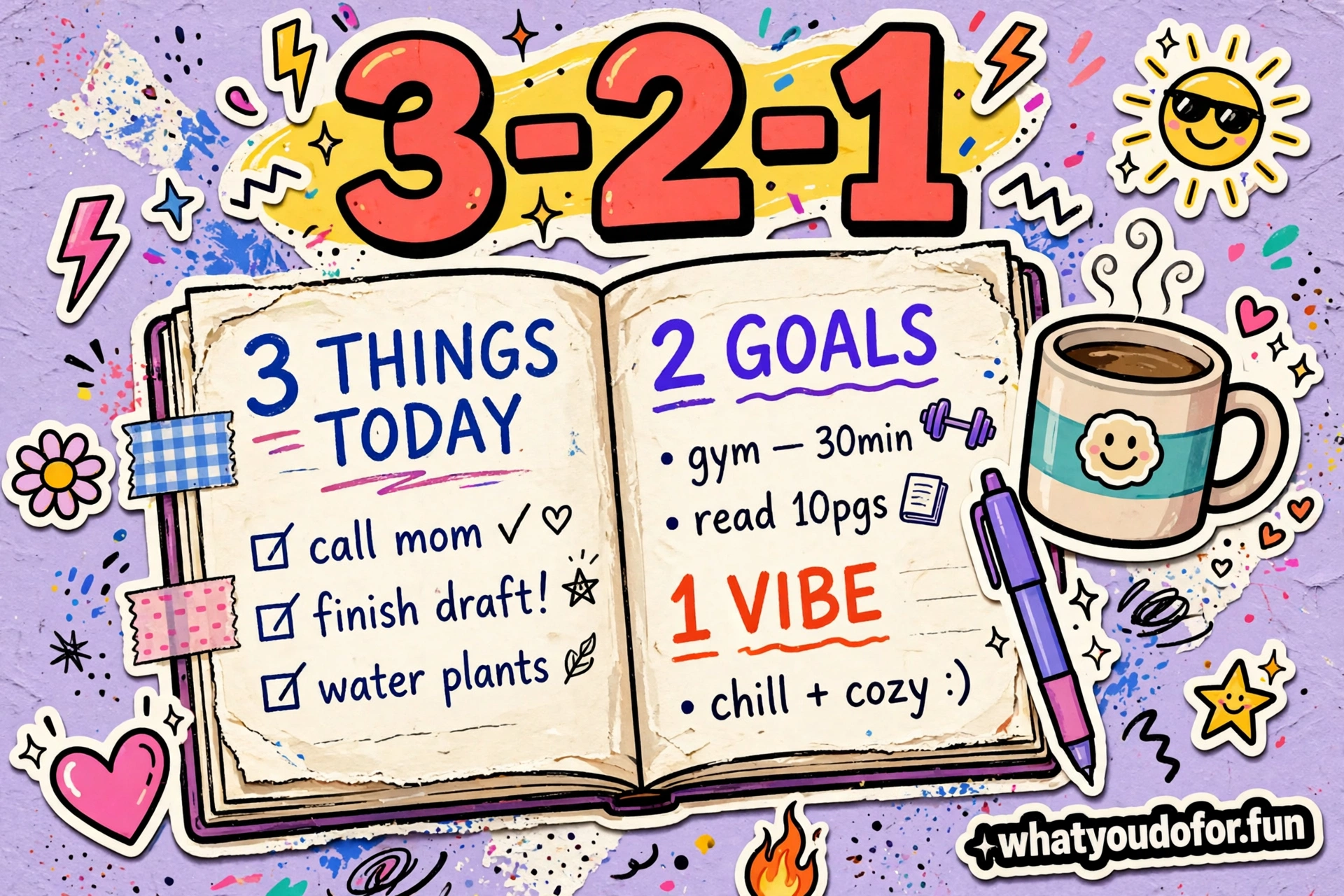
What Is the 3/2-1 Method of Journaling?
The 3/2-1 method of journaling is a six line daily entry: three things you are grateful for, two things you are excited about, and one thing you will accomplish today. That is the whole method. No essay, no blank page, no hour of soul searching before breakfast. You write six short lines, usually in about five minutes, and you are done. It is the smaller, punchier sibling of the 3-3-3 method we covered yesterday, and it suits people who want a morning habit that fits between the kettle boiling and the first email.
Like most numbered journaling routines, the name covers more than one version. Different guides mean different things by 3-2-1, and the version you pick changes what the habit actually does for you. This article explains the classic morning version first, because it is the one most beginner guides describe, then shows you the evening and bedtime versions, so you can choose the one that fits your day instead of following a version you did not sign up for.
What is the 3/2-1 method of journaling, in one minute?
The morning version, as described by the counselling practice OC Counseling in a guide first published in April 2024, runs like this. Write three things you are thankful for. Write two things you are excited about. Write one thing you are going to accomplish today. The guide recommends doing it first thing in the morning, in a physical notebook, before the day gets loud, and says the habit takes less than five minutes.
The shape is deliberate. Three gratitudes look backwards and ground you in what is already good. Two excitements look forwards and give the day something to look forward to. One intention narrows the whole day down to a single win. Gratitude, excitement, action: past, future, present, in six lines. That shrinking shape is the point. Every line has to earn its place, which is why the method works for people who freeze in front of a blank page and why it feels less like homework than a nine line routine.
One honest note before we go further. The named 3-2-1 routine itself has not been tested as a single intervention in a published trial that turned up in the sources used for this article. What has been tested, many times over, are its ingredients: gratitude writing, goal setting and short daily reflection. Treat the method as a pleasant, low cost daily habit with encouraging evidence behind its parts, not as a treatment. If journaling regularly makes you feel worse, or if you are struggling with low mood or anxiety, the journal is not the place to work that out alone. Talk to a clinician or a trusted support service instead. A notebook is a tool, not a therapist.
The morning version, line by line
Three things you are grateful for
Start with gratitude, and keep it small. The OC Counseling guide is explicit that gratitude can be ordinary: your bed, your kids, the warm shower you just took. Coffee counts. A text from a friend counts. A parking space counts. Small gratitudes are actually better than grand ones, because grand ones run out fast and small ones are everywhere.
The guide offers one useful challenge: try to pick three new things each day. It stops the list from becoming a copy paste of yesterday’s entry, and it trains you to notice good things as they happen, because you know you will need fresh ones tomorrow morning. If you get stuck, look at the last 24 hours rather than your life in general. What went right since yesterday morning? That window is always full.
Two things you are excited about
This is the line most people skip, and it is the one that makes 3-2-1 different from a plain gratitude list. Excitement can be an event, a conversation, a meal, a moment, a hope or a goal. It does not have to be profound. It just has to pull your attention forwards. A walk with a friend, a new episode of a show you love, a project you finally get to start, all count.
The guide’s advice here is simple: do not overthink it. People stall on this line because they think they need big news. You do not. On a grey Tuesday, being excited about soup for lunch is a perfectly good entry. The habit is not about performing enthusiasm. It is about giving your brain something to look towards instead of something to worry about.
One thing you will accomplish today
This is your anchor, and it has rules. It must be specific, actionable and achievable. Not “be productive”. Not “sort my life out”. Something like: send the email, finish the workout, write the proposal, call your friend. The guide suggests asking yourself one question: what is one thing that would make today a win?
Some days your one thing will be huge. Some days it will simply be “go for a walk”. Both count. Both move you forwards. The point of having exactly one is that a day with one finished thing feels better than a day with twenty unfinished ones, and a finished thing builds the confidence to come back tomorrow.
The evening version: three moments, two compliments, one act of self care
If mornings are chaos in your house, there is a second published version of the 3-2-1 method, designed for the end of the day. It comes from Jenny Selting Troester’s 3-2-1 Journal, published in December 2025, and it swaps the forward looking prompts for a backward looking, kinder set:
- 3: three meaningful moments from your day
- 2: two affirming compliments about your own strengths and goodness
- 1: one act of self care to prioritise
The evening version is a gentler habit. Instead of setting an intention, you collect evidence that the day held something good, then you say something kind about yourself, then you plan one small kindness for tomorrow. It suits people who want journaling to wind them down rather than wind them up, and it pairs naturally with the morning version: one sets the day, the other reviews it. You could even run both, morning and night, for twelve lines total. That is still a short entry.
A word on the compliments line, because it trips people up. A compliment to yourself is not bragging, and it does not have to be grand. “I was patient in a difficult meeting” is a compliment. “I cooked a proper meal instead of skipping dinner” is a compliment. If the line feels awkward, that is normal at first. Awkward is not the same as wrong, and it usually fades within a week.
The bedtime variant: three priorities, two gratitudes, one small win
A third version circulates on social media as the 3-2-1 nighttime rule, and it is worth knowing about because it is the most practical of the three for busy people. Before bed, you write:
- 3: three priorities for tomorrow
- 2: two things you are grateful for
- 1: one small win from today
This version does two jobs at once. It clears tomorrow’s to do list out of your head and onto paper, which many people find helps them switch off, and it ends the day on a win instead of a worry. If you are someone who lies awake rehearsing tomorrow, this is the version to try first. It takes about five minutes and it replaces the mental loop with a written list.
What the 3/2-1 method is not
The numbers 3-2-1 show up in several unrelated routines, and search results mix them together. Three are worth untangling so you do not follow the wrong one by accident.
First, the classroom 3-2-1 strategy. Teachers use it after a lesson: students record three things they learned, two things they found interesting, and one question they still have. It is a comprehension check, not a personal journaling habit, though it shares the same shrinking shape.
Second, the 3-2-1 focus method. This one is a six minute concentration warm up: three minutes of fairly intense physical activity, two minutes of brain dump journaling to clear the mind, and one minute of detailed planning. Only the middle step is journaling. It is a productivity trick, not a daily journal routine.
Third, the 5-4-3-2-1 grounding exercise. That counts five things you can see, four you can touch, three you can hear, two you can smell and one you can taste. It is a calming technique for stressful moments, and it has nothing to do with journaling at all. If a guide tells you to list things you can see, you have wandered into the wrong 3-2-1.
3/2-1 or 3-3-3: which method should you pick?
Yesterday we covered the 3-3-3 journaling method: nine lines in three lists of three, three gratitudes, three things to focus on, and three positive affirmations. So which one is right for you? It comes down to what you want from the habit and how much time you honestly have.
Pick 3/2-1 if you want the shortest possible habit, if mornings are rushed, or if you like the feeling of narrowing down to a single win. Six lines is hard to talk yourself out of, and the excitement line gives it a forward energy that pure gratitude lists lack.
Pick 3-3-3 if you want a more balanced entry, with room for affirmations alongside gratitude and focus, and if you have five unhurried minutes rather than three. Its weakness is that three lists can feel like homework on a tired day. The 3/2-1 method’s weakness is the opposite: it is so short that on a difficult day it can feel too thin, like it did not really hold anything.
The two methods are not rivals. They are both short templates for people who do not want a blank page, and the best one is the one you will still be using next month. If you cannot decide, try 3/2-1 for a week first. It is the easier habit to start, and you can always graduate to 3-3-3 later.
A worked example: one Tuesday in six lines
Here is what a finished 3-2-1 entry actually looks like, with nothing polished for publication. This is a normal Tuesday, not a perfect one:
3 things I am grateful for: the sun came out during my lunch break; my neighbour left the parcel in a safe place; the coffee machine worked first try.
2 things I am excited about: trying the new soup recipe tonight; the phone call with my sister on Thursday.
1 thing I will accomplish today: send the email I have been avoiding since Monday.
That is it. Six lines, no profound insights, no beautiful prose. Notice what the entry does: it finds three good things in an ordinary day, it gives the evening and the week something to look forward to, and it names the one task that has been weighing on the writer. If your entry looks like this, you are doing it right.
How to start: the seven day 3/2-1 trial
Do not commit to journaling forever. Commit to seven days, then decide. Here is the simplest way to run the trial.
Day 1: pick your version and your time. Morning version if you want to set the day, evening version if you want to review it, bedtime variant if tomorrow is what keeps you awake. Same time every day matters more than which time you choose.
Day 2: use a notebook you like. The OC Counseling guide recommends a physical notebook over an app, and the advice is practical rather than romantic: a notebook you enjoy opening is a notebook you will open. A cheap notebook you love beats an expensive one you are afraid to spoil.
Day 3: set a five minute timer. The timer is your permission to stop. Journaling sprawls when there is no end point, and sprawl is what kills the habit. When the timer rings, close the notebook, even mid thought.
Day 4: allow ugly entries. Bad handwriting, boring gratitudes, a one thing that is just “drink some water”. All fine. The habit is the win, not the prose.
Day 5: try the new gratitudes challenge. Three things you have not written before. This is the day the habit starts paying attention for you.
Day 6: read the week back. Six entries, thirty six lines. Look for patterns: what keeps appearing in your excitements, what your one things have in common. The pattern is often more interesting than any single entry.
Day 7: decide. Keep going, switch versions, or switch to 3-3-3. A week is enough data to know whether the habit fits your life. If it does not, that is useful information too, not a failure.
Five mistakes beginners make
1. Writing an essay. The method is six lines. If your entry regularly runs past a page, you have drifted into free writing, which is a fine habit but a different one. Set the timer and trust the shape.
2. Repeating the same three gratitudes. “Family, health, home” every day for a month teaches you nothing. The new things challenge exists for exactly this reason. Specific beats grand, every time.
3. Making the one thing vague. “Be better today” is not an intention, it is a wish. If you cannot tick it off tonight, it was not specific enough. Rewrite it until you can.
4. Only journaling on good days. Good days are easy to write about. The habit earns its keep on ordinary and difficult days, when three small good things are harder to find and therefore more useful to notice. If a day feels blank, write smaller: hot water, a working phone, five minutes of quiet.
5. Using the journal to ruminate. If you notice the same worry appearing in every entry, getting bigger each time, the notebook is amplifying it rather than releasing it. Switch to the evening version for a few days, which looks for moments and compliments instead of problems, or put the notebook down and talk to someone you trust.
Frequently asked questions
What is the 3/2-1 method of journaling?
In its most widely shared morning form, it is a six line daily entry: three things you are grateful for, two things you are excited about, and one thing you will accomplish today. Evening and bedtime versions use the same 3-2-1 shape with different prompts.
How long does the 3/2-1 method take?
About five minutes. The OC Counseling guide, which describes the morning version, says the habit takes less than five minutes, and most people find the six lines fit comfortably inside a five minute timer.
Should I do the 3/2-1 method in the morning or at night?
Morning if you want to set the day with an intention, evening if you want to review the day with moments and compliments, bedtime if tomorrow’s to do list is what keeps you awake. The best time is the one you will actually keep. Consistency matters more than the hour.
Is the 3/2-1 method the same as the 3-3-3 method?
No. The 3-3-3 method is nine lines in three lists of three: gratitudes, focuses and affirmations. The 3/2-1 method is six lines that shrink from three to two to one, and its morning version adds excitement and a single daily intention instead of affirmations. Both are short beginner templates, and you can read our guide to the 3-3-3 method to compare them.
Do I need a special journal for the 3/2-1 method?
No. Any notebook works, and the guides that describe the method recommend a physical notebook you enjoy opening rather than an app. Guided journals exist for the method, including a 90 day journal built around the evening version, but they are optional, not required.
What if I cannot think of two things I am excited about?
Go smaller. Excitement does not need news value. A meal you are looking forward to, a walk, a phone call, a show, a lie in at the weekend: all count. If even that feels hard, borrow from tomorrow instead of today. Anticipation counts as excitement, and it is often easier to find.
Sources
- OC Counseling, “The Power of 3-2-1 Journaling” (published 30 April 2024, updated 10 December 2025): the morning version, three gratitudes, two excitements, one accomplishment, under five minutes, physical notebook advice. https://www.occounseling.com/blog/the-power-of-3-2-1-journaling
- Jenny Selting Troester, “The 3-2-1 Journal for Women” (December 2025): the evening version, three meaningful moments, two affirming compliments, one act of self care. https://www.amazon.co.uk/dp/B0GDCMLQF3
- Lemon8, “Nighttime Journaling: A Simple 3-2-1 Reflection Technique”: the bedtime variant, three priorities for tomorrow, two gratitudes, one small win. https://www.lemon8-app.com/@blessedclassy/7491355147042308651?region=us
- University of British Columbia, “3-2-1” classroom strategy sheet: three ideas, two examples, one question, the education strategy the journaling method is often confused with. https://ctl.ok.ubc.ca/wp-content/uploads/sites/186/2021/01/321.pdf
- Upworthy, “Easy ‘3-2-1 method’ uses neuroscience to trick your brain into incredible concentration”: the six minute focus warm up, three minutes of movement, two minutes of brain dump journaling, one minute of planning. https://www.upworthy.com/easy-3-2-1-method-uses-neuroscience-to-trick-your-brain-into-incredible-concentration/
Related reading

Related Posts
What Is the 2-2-2 Rule for Couples?

What Is the 7 7 7 Rule for Couples?