Why Did the Victorians Bob for Apples? 7 Weird Autumn Traditions Explained
Autumn traditions explained in plain terms: nearly every odd ritual of the season, from biting apples out of a bucket of water to wandering lost through a field of corn, began as something far stranger than a party game. What looks like harmless seasonal fun was once fortune telling, religious ritual, or an act of protest. This is the weird, real history behind seven of autumn’s oddest traditions, and why they stuck around long after anyone remembered what they were for.
Why Did the Victorians Bob for Apples?
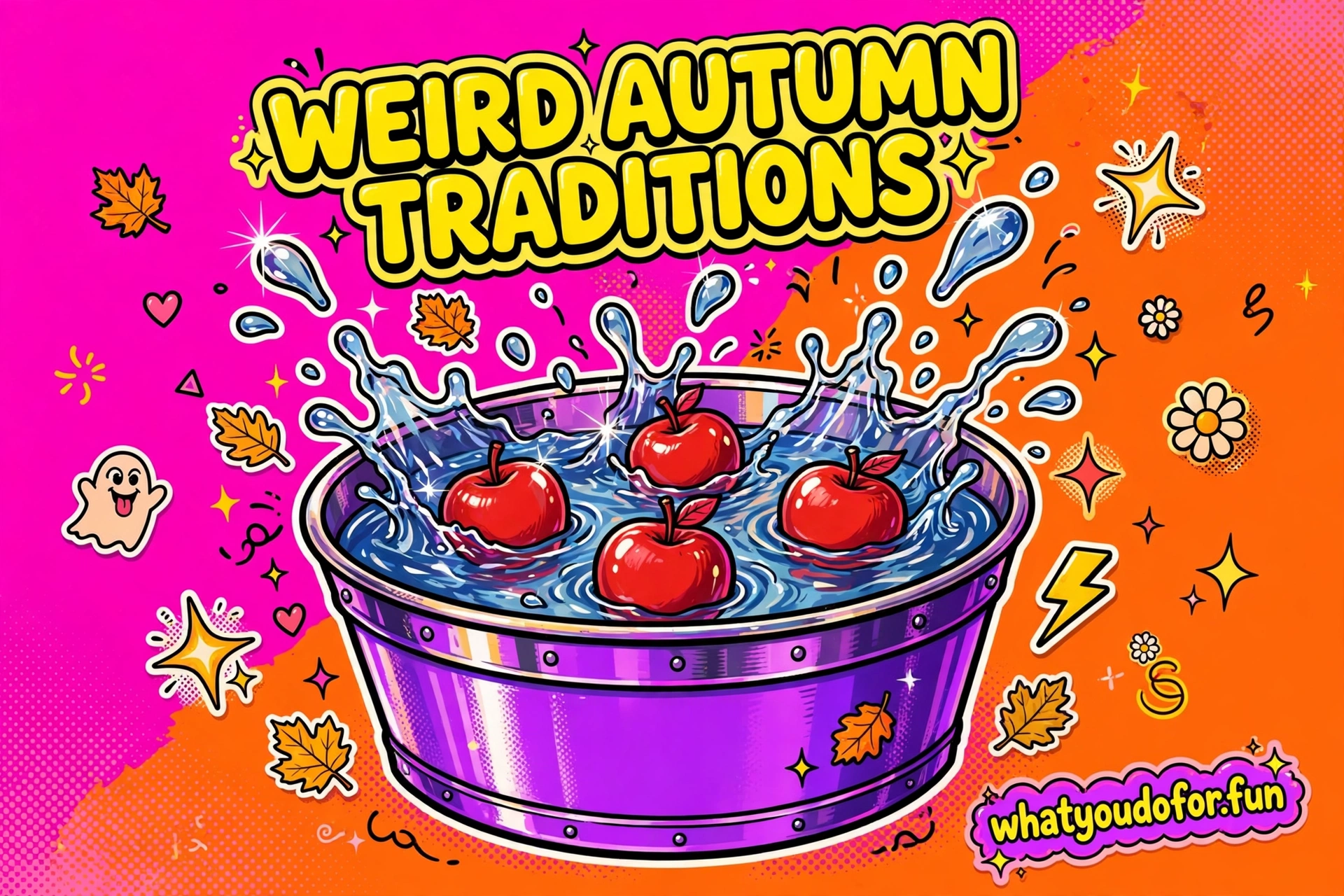
Bobbing for apples feels like a children’s party game, but for most of its history it was a serious bit of fortune telling. The apple has been a symbol of love and fertility across European cultures for thousands of years, and apples, apple peels and pips were long used to peer into the romantic future, according to fruit historian Joan Morgan in an NPR interview.
In the Victorian version of the game, a young woman would secretly mark an apple with the name of a suitor before it went into the barrel. The rules were brutally specific: bite the right apple in one go and the couple were destined for love, need two attempts and the romance would fade, take three or more and the relationship was doomed from the start. In another version, women raced to be the first to bite an apple, because the winner would be the first to marry. Some even kept the bitten apple under their pillow, hoping to dream of their future husband.
Where the game came from is murkier, but the best-supported theory traces it through the Roman festival of Pomona, goddess of fruit trees, which merged with the Celtic festival of Samhain when the Romans brought their customs to Britain. Samhain marked the end of the harvest and the start of winter, a time when the boundary between this world and the next was believed to be thin, which is exactly when fortune telling was thought to work best.
The game even had different names depending on where you played it. In Scotland it was called “dooking” or “ducking”, in northern England “duck-apple”, and in Ireland “snap apple”, which was also the Irish name for a hanging-apple variant where the fruit dangled on a string and players bit it with their hands tied. In Newfoundland and Labrador, Halloween itself is still called Snap Apple Night.
Why Was the First Corn Maze Built Only in 1993?
Mazes feel ancient, and they are. Labyrinths used for ritual and procession go back around 4,000 years, and the garden maze was a staple of wealthy estates for centuries. But nobody thought to plant one in a cornfield until Don Frantz looked down at the Midwest’s contoured crop lines from a cross-country flight and wondered what an English garden maze would look like built from corn.
In 1993 Frantz launched the first modern corn maze in Annville, Pennsylvania: a dinosaur-shaped path through the field that he called the “Amazing Maize Maze”. It was designed purely for fun, to draw a few extra visitors during the slow season, and it worked. Parents who got lost in corn mazes as teenagers now bring their own children, and what began as a novelty is now a full autumn industry. By 2024, more than 500 American businesses had corn mazes mentioned in customer reviews, and a single maze can draw thousands of visitors in a season, sometimes earning the farm more than the corn harvest itself.
Modern mazes are designed on computers and planted with GPS-guided tractors, but the appeal is the same as it was in 1993: paying to be gloriously, deliberately lost for an hour.
Why Did People Carve Turnips Before Pumpkins?
Long before the pumpkin, the jack-o’-lantern was a turnip. Irish families carved frightening faces into turnips and potatoes and set them in windows to ward off wandering spirits, a custom tied to the legend of Stingy Jack, the trickster who bargained with the devil and was left to roam the dark with only a burning coal inside a hollowed turnip for light.
When Irish immigrants brought the tradition to America in the 1800s, they discovered the native pumpkin: bigger, softer, and far easier to carve than a rock-hard turnip. The pumpkin won, and the turnip lantern became a folk memory, though you can still spot old photographs of the gnarled originals. We covered the full Stingy Jack story in our piece on why we carve pumpkins.
Why Do We Light Bonfires on 5 November?
Bonfire Night looks like a celebration, and it is, but it started as thanksgiving for a mass murder that never happened. On the night of 4 November 1605, Guy Fawkes was caught in a cellar beneath the House of Lords guarding 36 barrels of gunpowder, part of a Catholic conspiracy to blow up King James I and Parliament at the state opening the next day.
When news of the king’s lucky escape spread, Londoners lit bonfires in the streets. Parliament formalised the gratitude in January 1606 with the Observance of 5th November Act, the Thanksgiving Act, which made 5 November an annual day of public thanksgiving with church services, bell ringing and bonfires. The Act stayed on the books until its repeal in 1859, but the bonfires never stopped.
Over the centuries the night picked up its extras: fireworks, toffee apples, and the “guy”, an effigy of Fawkes burned on the fire, a tradition that gave generations of children the phrase “a penny for the guy”. What began as a solemn state ritual of survival is now mostly an excuse to stand around a fire eating something sticky, which is arguably an improvement.
What Is Mischief Night?
In Yorkshire and parts of northern England, the night before Bonfire Night had its own tradition, and it was not about fireworks. Mischief Night, on 4 November, was the one evening when children roamed the streets playing pranks: knocking on doors and running away, smearing jam on door knobs, lifting gates off their hinges, and tying bin lids to door handles. One widely repeated belief held, incorrectly, that the police were not allowed to arrest anyone on Mischief Night.
The custom is older than its November date suggests. The earliest records, from the 1790s in Lancashire, put it on 30 April, May Eve, when young men settled grudges with pranks like uprooting fences and setting livestock loose, defending themselves with the line “it’s nobbut th’Mischief Neet”. Victorian folklorists suggested the date shifted to 4 November as the country urbanised, landing conveniently on the eve of Bonfire Night, and some even linked it to York, Guy Fawkes’s birthplace, noting that Fawkes was up to his own mischief on the evening of 4 November 1605.
From the 1950s to the late 1980s, Mischief Night was the big night in the north, while Halloween on the 31st was barely an event. In recent decades Halloween has muscled in, but in Yorkshire the pranks of 4 November still have their defenders.
Where Did Trick-or-Treating Actually Come From?
Trick-or-treating looks like an American invention, but its ingredients are medieval. On All Souls’ Day, 2 November, poor people in medieval England went “souling”: they visited the homes of wealthier families and received small pastries called soul cakes in exchange for a promise to pray for the souls of the homeowners’ dead relatives. Children later took up the practice, going door to door asking for food, money or ale.
In Scotland and Ireland, the parallel tradition was “guising”. Young people dressed in costume and visited households, but they had to earn their treat by performing: singing a song, reciting a poem, telling a joke, or doing some other “trick”, in exchange for fruit, nuts or coins. That performance-for-reward exchange is the direct ancestor of the modern bargain, except today’s costume is usually bought and the poem is usually skipped.
Immigrants carried guising to North America in the 1800s, and the phrase “trick or treat” first appeared in print in a Canadian newspaper in 1927, describing children in Alberta “demanding edible plunder”. The custom nearly died during wartime sugar rationing, but Charles Schulz’s Peanuts strip in 1951 and a Disney cartoon featuring Donald Duck in 1952 turned it into the defining ritual of the American Halloween. So the threatening bit is Canadian, the dressing up is Scottish and Irish, and the candy industrial complex is Hollywood. Once the door-to-door rounds are done, our Halloween movie marathon list picks up where the trick-or-treating ends.
Why Do We Eat Toffee Apples in Autumn?
Toffee apples are a harvest-season treat for a simple reason: they arrive in the wake of the apple harvest, when apples are at their cheapest and best. But the sticky red coating has its own odd origin story.
Candy-coated apples were sold in London as early as the 1890s. Then, in 1908, a Newark, New Jersey candy maker named William W. Kolb was experimenting in his shop with a red cinnamon candy mixture for the Christmas trade. He dipped some apples into it, stuck them on sticks, and put them in the window as a display. Customers ignored the display concept entirely and asked to buy the apples. He sold the whole first batch for five cents each, then thousands a year, and the candy apple spread from the Jersey Shore to circuses and fairs across America.
The softer caramel apple came later, invented in the 1950s by a Kraft Foods salesman looking for a use for leftover Halloween caramels. In Britain the toffee apple became a Bonfire Night staple, which makes sense: a treat you eat with your hands, standing around a fire, in the one month when apples are everywhere.
Autumn Traditions Explained: The Short Version
Strip away the centuries and autumn’s weirdest traditions are all doing the same job: marking the moment the year turns dark. Apple bobbing and snap apple were fortune telling for the season when the harvest ended and the future felt uncertain. Turnip lanterns and bonfires were protection and thanksgiving when the nights closed in. Mischief Night was a pressure valve for young people with too much energy and too little daylight. The corn maze is the newest of the lot, a 1990s invention that accidentally became a tradition by giving autumn the same thing the old rituals did: a reason to gather, get a little lost, and laugh about it. For more ways to squeeze the season dry, see our 15 cosy autumn bucket list ideas for a lazy October weekend.
Frequently Asked Questions
Why did the Victorians bob for apples?
The Victorians treated apple bobbing as fortune telling about love. A woman would mark an apple with a suitor’s name; biting it in one attempt meant the couple were destined for each other, two attempts meant the romance would fade, and three or more meant it was doomed. The tradition grew out of much older apple divination customs tied to Samhain and the Roman festival of Pomona.
What is snap apple?
Snap apple is the Irish variant of apple bobbing. Instead of floating in water, the apple hangs from a string and players try to bite it with their hands tied behind their backs. The name stuck so firmly that in Newfoundland and Labrador, Halloween night itself is still called Snap Apple Night.
When was the first corn maze built?
The first modern corn maze was built in 1993 in Annville, Pennsylvania, by Don Frantz. Inspired by the sight of contoured crop lines from an aeroplane, he carved a dinosaur-shaped path through a cornfield and called it the ‘Amazing Maize Maze’. Ornamental labyrinths are far older, going back around 4,000 years, but nobody had planted one in corn before.
Why do we celebrate Bonfire Night on 5 November?
Bonfire Night marks the failure of the Gunpowder Plot of 1605, when Guy Fawkes was caught guarding gunpowder beneath the House of Lords. Londoners lit celebratory bonfires, and Parliament’s Observance of 5th November Act of 1606 made the date an annual day of thanksgiving. The fireworks, toffee apples and burning ‘guy’ came later.
What is the difference between souling and guising?
Souling was a medieval English custom on All Souls’ Day: poor people visited wealthier homes and received soul cakes in exchange for prayers for the dead. Guising was the Scottish and Irish custom of dressing in costume and performing a song, poem or joke in exchange for fruit, nuts or coins. Guising is the closer ancestor of modern trick-or-treating.
Who invented the toffee apple?
The red candy apple is credited to William W. Kolb, a candy maker in Newark, New Jersey, who in 1908 dipped apples into a red cinnamon candy mixture meant as a Christmas window display. Customers bought the whole batch at five cents each. Candy-coated apples had already been sold in London in the 1890s, and the caramel apple followed in the 1950s.

Related Posts
What Is the 2-2-2 Rule for Couples?
What Is the 7 7 7 Rule for Couples?