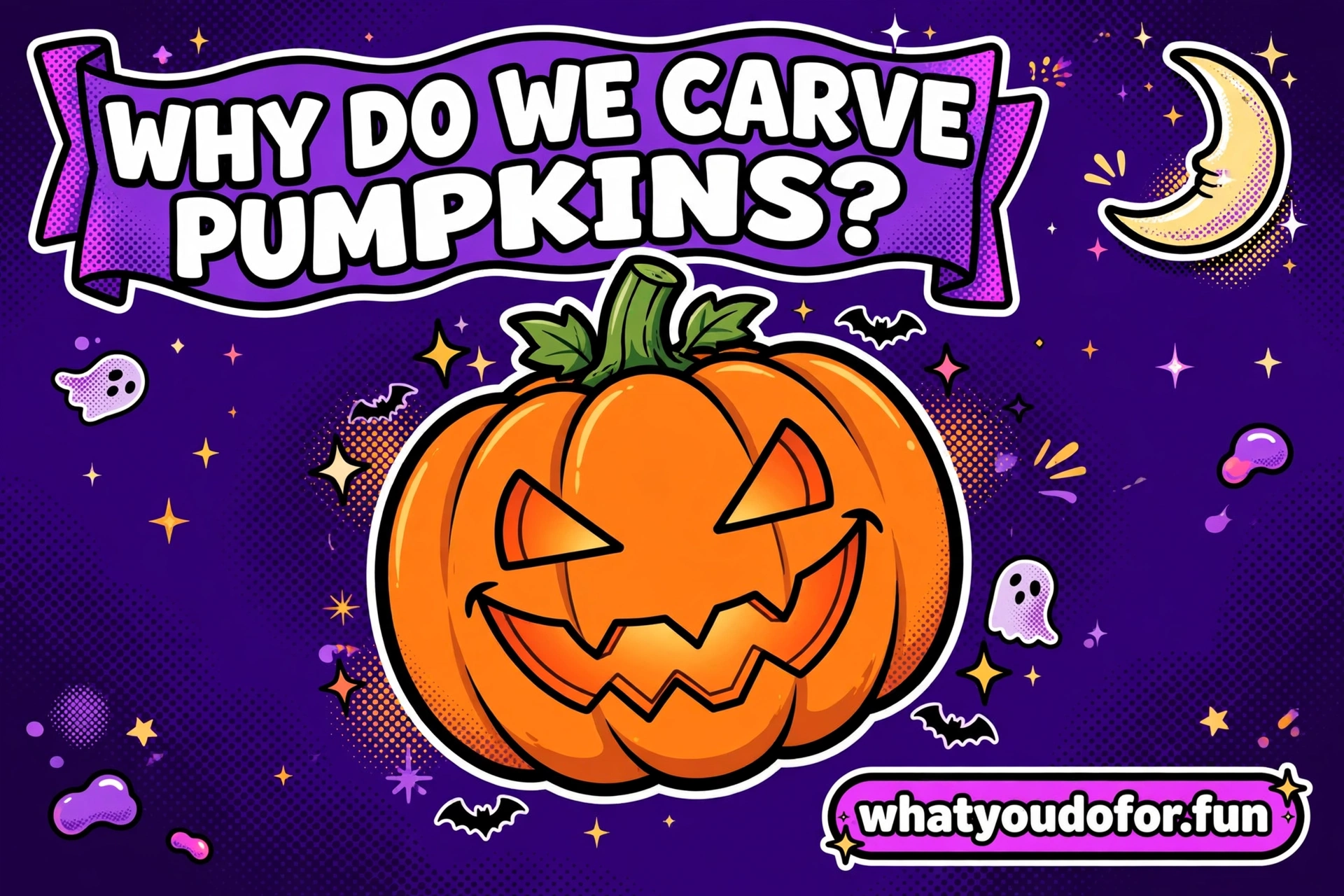
Why Do We Carve Pumpkins? The Creepy Legend of Stingy Jack
Every October, millions of us do the same odd little ritual. We buy a pumpkin, saw off its top, scoop out its guts with our hands, and cut a grinning face into its side. Then we stick a candle inside and put it on the doorstep.
It is, when you think about it, a deeply strange thing to do. Who looked at a vegetable and thought: yes, this should have a face and a candle? The answer turns out to be a story about a legendary con artist who outsmarted the Devil, was refused entry to both Heaven and Hell, and ended up wandering the Earth with a glowing vegetable as his only light.
So why do we carve pumpkins? The short answer: the tradition comes from Ireland, where people carved faces into turnips to frighten away wandering spirits, a custom named after a folk-tale trickster called Stingy Jack. Irish immigrants carried it to America in the 19th century, where the native pumpkin proved bigger, softer and far easier to carve than a turnip. The face changed its vegetable, but it never lost its original job: keeping the darkness at bay.
Who was Stingy Jack?
Stingy Jack is the star of a very old Irish folk tale, and he is not a hero. The stories describe him as a clever, miserly drunkard who lived by lies, tricks and petty scams. The name “Stingy” is the clue. He was the kind of man who would dodge his round at the pub and brag about it afterwards.
What made him famous was not any single scam, but the scale of his ambition. Jack did not just trick his neighbours. He tricked the Devil. Not once, but, according to the most-told versions, twice. And each time he got away with it, he sealed his own fate a little further.
Irish folk tradition loved a trickster, and Jack was a popular character in 18th-century tales, especially those told around All Hallows’ Eve, when the boundary between the living and the dead was thought to be at its thinnest.
How did Stingy Jack trick the Devil twice?
The two best-known versions of Jack’s cons are told in dozens of variations, but the shape of the story stays the same. Jack uses his wits, the Devil underestimates him, and Jack wriggles free.
The coin trick. One night, Jack invited the Devil to share a drink with him. True to his name, Jack had no intention of paying. Instead, he persuaded the Devil to transform himself into a coin so he could use it to settle the bill. But Jack did not spend the coin. He slipped it into his pocket, right next to a silver cross he was carrying. Trapped by the holy symbol, the Devil could not change back into his original form. Jack only freed him after extracting a promise: the Devil would leave him alone for ten years, and would never claim his soul.
The apple tree trick. In the other famous version, Jack talked the Devil into climbing an apple tree to pick some fruit. While the Devil was up in the branches, Jack carved crosses all the way around the trunk. The Devil, stuck in the tree by the power of the crosses, could not climb down. Again, Jack named his price for setting him free: the Devil promised never to claim his soul, and in some tellings, to leave Jack alone forever.
Both stories end the same way. Jack cheats death for a while. But nobody cheats it forever.
Why is he called Jack of the Lantern?
When Jack finally died, his lifetime of trickery caught up with him. Heaven turned him away because of his life of sin. But the Devil kept his promise and would not take him into Hell either. So Jack was cursed to roam the Earth forever as a spirit in limbo, belonging nowhere.
As he left the gates of Hell, the Devil threw him a single hot ember to light his way in the dark. Jack placed the ember inside a hollowed-out turnip to keep it burning and stop it going out, and set off into the night. According to the legend, you might still see his spirit on All Hallows’ Eve, carrying his turnip lantern through the darkness.
The wandering figure became known as “Jack of the Lantern”, which over the years was shortened to “jack-o’-lantern”. Every carved pumpkin on a doorstep is, in a sense, a portrait of him.
What did people carve before pumpkins?
Here is the part most people get wrong. The pumpkin was never the original lantern. Before pumpkins, there were turnips.
The tradition of carving goes back to the Celtic festival of Samhain, celebrated from 31 October to 1 November. Samhain marked the end of the harvest season and the beginning of winter, and it was believed to be the night when the veil between the living and the dead was at its thinnest. As part of the Samhain celebration, Celts would carry home an ember from the communal bonfire at the end of the night, holding it in a hollowed-out turnip. It was a lantern, long before it was a decoration.
In Ireland and Scotland, carved turnips became a widespread Halloween custom a few hundred years ago. People hollowed out turnips, and also beets, potatoes and other root vegetables, cut grotesque faces into them, and placed candles or embers inside. The glowing vegetables were set on windowsills and near doorways.
These were not just decorations. Folk tradition held that the lanterns would ward off Stingy Jack himself and other wandering spirits on Halloween night, and they also served as representations of the souls of the dead. The face was doing a job: a scary face for a scary night.
Why did turnips become pumpkins?
The pumpkin entered the story through migration. Irish families emigrating to America in the 19th century, in large numbers during and after the Irish Potato Famine of the 1840s and 1850s, brought the carving tradition with them.
In America they found something better than turnips. Pumpkins are native to the Americas, they were large and plentiful, and, crucially, they were far easier to carve than a tough little turnip. Anyone who has tried to hollow out a raw turnip, dense and woody and barely bigger than a tennis ball, will understand the appeal of switching to a soft, roomy pumpkin with a convenient flat face.
So the pumpkin took the place of the turnip, and the face of the jack-o’-lantern tradition went with it. Over the years, carving pumpkins became the fun Halloween activity we know today, but it was really a merger of old folklore and a new vegetable.
Why do we still do it?
The short, practical answer is that it is fun, and Halloween loves a ritual. But the legend underneath gives the pumpkin a little more bite. Every time you cut a face into a pumpkin, you are re-enacting a custom that was once deadly serious: lighting a lamp to keep wandering spirits away on the darkest night of the year.
And somewhere in the story is a moral, too. Stingy Jack’s cleverness saved him from the Devil twice, but it could not save him from himself. He outsmarted everyone and ended up with nothing but a turnip and an ember. Perhaps that is why the lanterns were carved with such frightening faces. They were a reminder, glowing on the windowsill, of what happens to people who live by tricks.
Frequently asked questions
Who was Stingy Jack?
Stingy Jack is a character from Irish folklore, a miserly trickster famous for cheating the Devil. After death he was refused entry to both Heaven and Hell, and was condemned to wander the Earth carrying a burning coal inside a hollowed-out turnip. That glowing turnip made him “Jack of the Lantern”.
What did people carve before pumpkins?
People in Ireland and Scotland carved faces into turnips, beets, potatoes and other root vegetables. The custom goes back to the Celtic festival of Samhain, when revellers carried bonfire embers home in hollowed-out turnips, and later carved turnip lanterns were set on windowsills to ward off wandering spirits.
Why is a carved pumpkin called a jack-o’-lantern?
The name comes from the legend of Stingy Jack. His ember-in-a-turnip became known as “Jack of the Lantern”, shortened over time to “jack-o’-lantern”. When the carving tradition moved to America and pumpkins replaced turnips, the name moved with it.
When did pumpkins replace turnips for Halloween?
The switch happened in the 19th century. Irish immigrants brought the turnip-carving tradition to America during and after the 1840s and 1850s, and replaced turnips with pumpkins, which are native to the Americas, much larger and far easier to carve.
Why do people put carved pumpkins outside their doors?
The original purpose of the lanterns was protection. Folk tradition held that the glowing carved faces, placed on windowsills or near doorways on Halloween night, would ward off Stingy Jack and other wandering spirits, and they also represented the souls of the dead during Samhain.

Related Posts
What Is the 2-2-2 Rule for Couples?

What Is the 7 7 7 Rule for Couples?